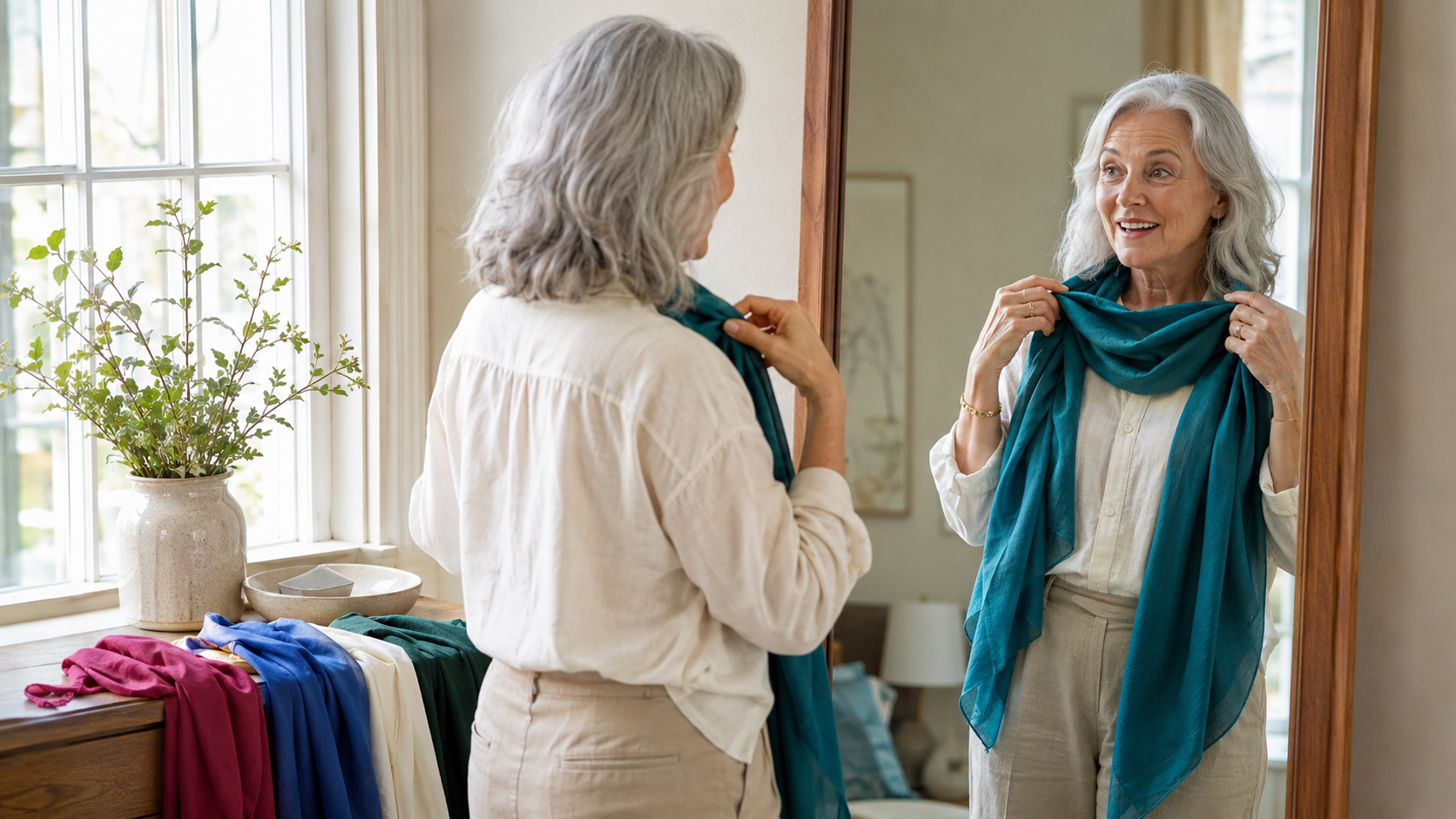
The Colors That Make You Look More Alive—Without Changing Anything Else About Your Style
By Katie Quinn
Sometimes an outfit fits beautifully, feels comfortable, and reflects your personal style—yet something still seems slightly off.
You look in the mirror and feel tired, washed out, or less vibrant than you expected. Your first instinct may be to change the shape of the outfit, add more makeup, or decide the garment simply does not work anymore.
But the problem may not be the style.
It may be the color near your face.
The right color can make your eyes appear brighter, your skin look more even, and your natural hair color feel more intentional. It does not make you look like a different person or erase the years from your face.
It simply allows the color already present in you to become more visible.
Color Can Change the Way We See the Face
Color reflects light onto the skin.
A shade that works well with your natural coloring may soften the appearance of shadows, bring warmth to your complexion, and make your eyes stand out.
A less flattering shade can emphasize redness, dark circles, uneven tone, or sallowness—even when the garment itself is lovely.
This does not mean certain colors are forbidden after 50.
The question is not, “Am I too old to wear this?”
The more helpful question is, “What happens to my face when I wear this color?”
You may love pale beige but notice that it makes your complexion disappear. You may have avoided bright blue for years, only to discover that it makes your eyes look clearer and your silver hair glow.
Your mirror can tell you more than an age-based style rule ever will.
Begin With Warm, Cool, or Neutral
You may have heard about warm and cool undertones. Although personal coloring is more nuanced than a single category, undertone can offer a useful starting point.
Warm Undertones
Warm skin often has golden, peach, or yellow notes.
Colors that may feel especially harmonious include:
- Warm coral
- Peach
- Tomato red
- Olive
- Moss green
- Turquoise
- Camel
- Warm ivory
- Rust
- Golden brown
If pure white feels harsh but cream makes your complexion look softer, you may lean warm.
Cool Undertones
Cool skin often carries pink, rosy, red, or bluish notes.
Colors that may work beautifully include:
- Berry
- Raspberry
- Blue-red
- Cobalt
- Sapphire
- Plum
- Blue-green
- Charcoal
- Cool navy
- Soft white
If silver jewelry seems to brighten your skin more than yellow gold, or crisp white feels more natural than cream, you may lean cool.
Neutral Undertones
Neutral skin contains a balance of warm and cool notes.
You may be able to wear colors from both groups, especially shades that are not extremely warm or cool.
Your best colors might include:
- Teal
- Jade
- Soft navy
- Rose
- Aubergine
- Medium gray
- Watermelon
- Muted turquoise
These categories are guides, not rules. Your preferences, hair color, eye color, and the intensity of a shade also affect how it looks.
Pay Attention to Brightness
Two women with similar skin tones may need very different versions of the same color.
One may look wonderful in clear, saturated cobalt. The other may feel more at home in soft denim blue.
This difference is often about intensity.
Clear colors are strong and vivid. Muted colors contain more gray and feel softer or more blended.
If bright colors seem to enter the room before you do, try softened versions:
- Sage instead of emerald
- Dusty rose instead of hot pink
- Denim instead of electric blue
- Soft plum instead of vivid purple
- Muted teal instead of bright turquoise
If pale or muted shades make you look tired, try clearer colors:
- Cobalt instead of powder blue
- Raspberry instead of dusty mauve
- Emerald instead of sage
- True red instead of muted brick
- Deep turquoise instead of pale aqua
The goal is not to choose the quietest or boldest color. It is to find the amount of intensity that supports your natural coloring.
Contrast Matters More Than Many Women Realize
Contrast is the difference between the lightest and darkest parts of your natural coloring.
If you have dark eyes, darker brows, and light skin or silver hair, you may naturally have higher contrast. Outfits with some definition—such as navy and white, black with a brighter accent, or a deep jacket over a lighter blouse—may feel balanced.
If your hair, skin, and eyes are similar in depth, you may have lower contrast. Softer combinations such as cream and camel, sage and ivory, or dusty rose and taupe may feel more harmonious.
This can change when your hair becomes gray or white.
A woman who once looked balanced in head-to-toe beige may find that she now needs a little more depth near her face. Another woman may discover that the stark black she wore for decades suddenly feels too strong beside softer silver hair.
Neither needs an entirely new wardrobe. A scarf, necklace, cardigan, or lipstick can restore the contrast that feels missing.
White Is Not Just One Color
A white blouse is a classic wardrobe piece, but not every white creates the same effect.
Crisp optic white has a cool, clear appearance. Soft white is slightly gentler. Ivory and cream contain more warmth.
Hold several versions near your face in natural daylight.
Does crisp white make you look bright and defined—or does it seem harsh? Does cream add warmth—or make your skin look yellow?
Choose the white that brings your face forward instead of the one fashion rules call essential.
Black May Need a Supporting Role
Black is useful, elegant, and easy to coordinate. You do not need to remove it from your wardrobe because you reached a certain age.
But black worn directly beneath the face can sometimes create shadows or feel severe, particularly when hair and brows have softened.
If you love black but feel it no longer loves you back, try:
- Wearing a flattering scarf near your face
- Choosing a softer neckline that reveals more skin
- Adding silver, pearl, or colorful earrings
- Wearing a jacket open over a brighter blouse
- Replacing some black pieces with charcoal, navy, espresso, or deep plum
- Adding a lipstick or blush color that restores warmth
Black can remain part of your style without having to do all the work.
Gray Hair Can Open an Entirely New Palette
Going gray does not mean your wardrobe must become pale, neutral, or conservative.
Silver and white hair can look striking beside rich jewel tones, clear blues, cool pinks, deep greens, charcoal, white, and certain warm colors.
The shades that worked when your hair was brown, red, or blonde may not produce the same effect now. That is not a loss. It is an invitation to experiment.
Try colors you once avoided.
Hold cobalt, raspberry, teal, lavender, forest green, and coral near your face. You may be surprised by what happens when your new hair color meets a shade you never considered before.
The Daylight Test
Store lighting and bathroom lighting can distort color.
The simplest way to evaluate a shade is to stand near a window during the day with minimal makeup.
Hold the color directly beneath your face and observe:
- Do your eyes become more noticeable?
- Does your skin look more even?
- Are shadows more or less obvious?
- Do you see your face first or the garment first?
- Do you appear refreshed—or suddenly tired?
- Does the color feel like you?
Then compare it with a similar shade.
Try navy beside black, cream beside white, coral beside pink, or teal beside olive.
You are not looking for perfection. You are looking for the color that makes your face feel present.
Taking a quick photograph in the same lighting can make differences easier to see.
You Do Not Need to Replace Your Wardrobe
Finding your most flattering colors does not require buying everything again.
Begin with what sits closest to your face:
- Scarves
- Cardigans
- Jackets
- Blouses
- Sweaters
- Earrings
- Necklaces
- Eyeglass frames
- Lip color
If a favorite dress is not your best shade, add a jacket, wrap, or necklace that introduces a more supportive color near your face.
You can also continue wearing less flattering colors below the waist. Pants, skirts, shoes, and handbags have very little effect on the complexion.
Color placement matters more than having a perfectly coordinated closet.
Five Colors Worth Testing
Every woman is different, but these colors are often versatile enough to deserve a place in your daylight experiment.
Teal
Teal sits between blue and green and can work with many warm, cool, and neutral complexions. Try both a deep blue-teal and a softer green-teal.
Soft Navy
Navy provides definition without the intensity of black. It can be especially useful in jackets, sweaters, and tops.
Raspberry
Raspberry offers life and color without necessarily feeling overly bright. It can work beautifully with silver, brunette, blonde, and red hair.
Deep Green
Forest, pine, or rich jade can bring out green, blue, hazel, and brown eyes. Test warmer and cooler versions.
Your Best White
Whether it is crisp white, soft white, ivory, or cream, finding your best light neutral can make the rest of your wardrobe easier to coordinate.
These are simply starting points. Your best color might be turquoise, marigold, lavender, red, or something completely unexpected.
Choose a Personal Signature Color
Once you discover a color that consistently makes you feel good, allow it to become part of your signature.
You might wear it in:
- A favorite scarf
- A pair of earrings
- A handbag
- A cardigan
- Your eyeglass frames
- Your lipstick
- A patterned blouse
A signature color makes getting dressed easier and helps your wardrobe feel more intentional.
It can also become part of how people remember you: the woman who always looks beautiful in turquoise, raspberry, red, or soft blue.
Flattering Does Not Mean Mandatory
There will be colors you love even though they are not technically your most flattering.
Wear them.
Personal style should never become another system of rules that makes you afraid to choose incorrectly.
If mustard yellow makes you happy but does not do much for your complexion, wear it as a handbag, shoe, skirt, or patterned accent. If you adore beige, pair it with earrings, a scarf, or lip color that gives your face more definition.
Joy is part of what makes a woman look alive.
The Best Color Helps You See Yourself
The purpose of wearing flattering colors is not to appear younger.
It is to feel more visible.
The right color does not hide your age, change your shape, or require you to abandon the style you have spent years developing. It simply brings more attention to your eyes, your expression, and the natural color that already belongs to you.
Stand near a window. Gather a few shirts or scarves. Try them one at a time without judging yourself.
Notice what brightens you.
You may discover that your wardrobe does not need a makeover.
It may simply need a little more of the colors that help you look—and feel—fully alive.
Leave a Reply