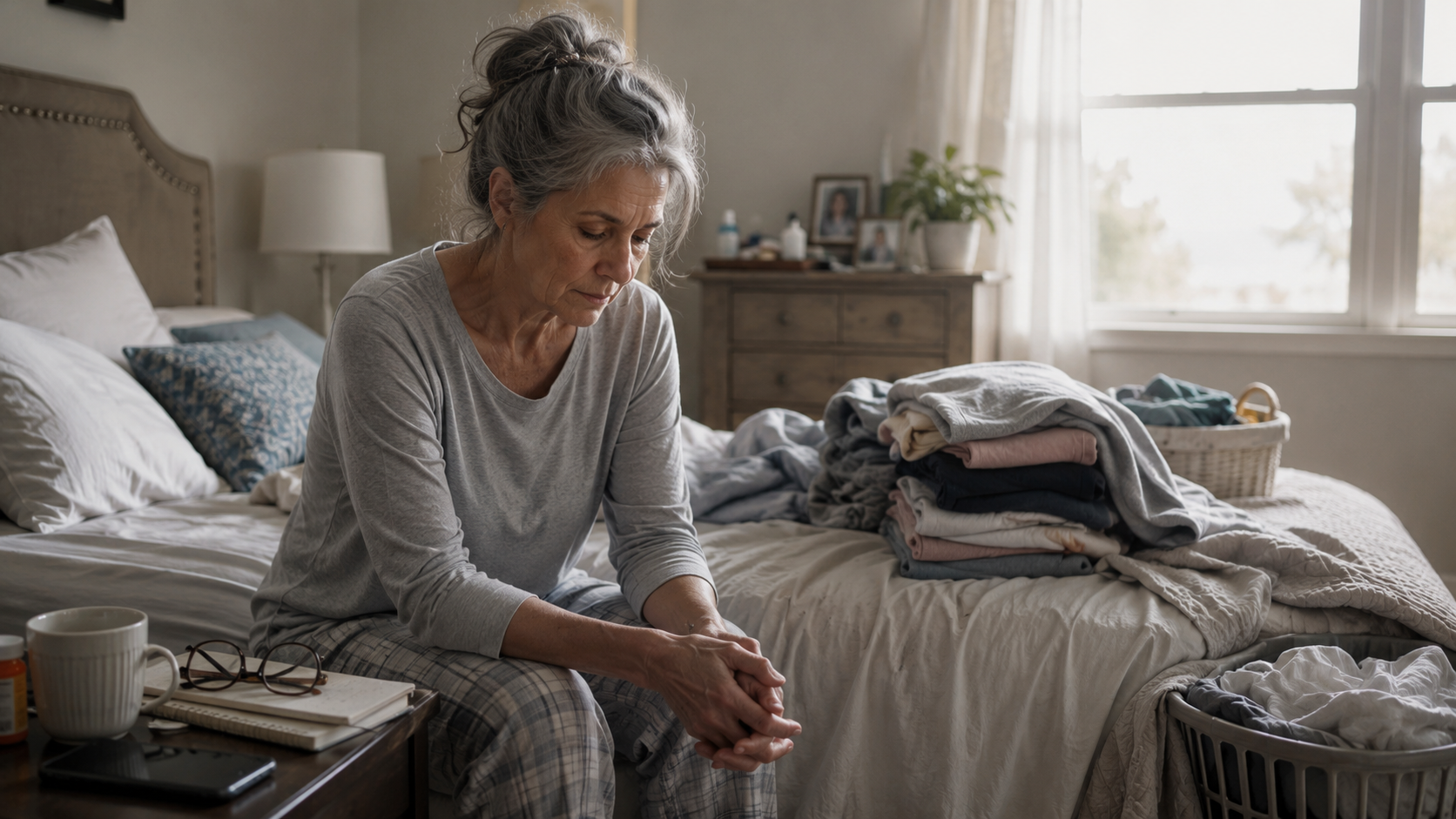
There comes a morning when a woman sits on the edge of the bed and stares at the floor longer than usual.
Not because she does not want to get up.
Not because she is ungrateful.
Not because she has given up.
But because her body already knows what the day is going to ask of her.
The dishes.
The phone calls.
The appointments.
The bills.
The text messages.
The people who need her.
The people who assume she will handle it.
The things no one sees but everyone benefits from.
And before her feet even touch the floor, she is already tired.
For years, she has been the one who remembers.
The birthday cards.
The prescriptions.
The grocery list.
The family tension.
The doctor’s appointment.
The grandchild’s schedule.
The aging parent’s needs.
The husband’s mood.
The adult child’s crisis.
The friend who needs listening.
The home that keeps needing something.
The life that keeps needing her.
And somewhere along the way, people started calling her strong.
Strong because she kept going.
Strong because she handled it.
Strong because she did not fall apart where anyone could see.
Strong because she smiled at the family gathering, answered “I’m fine,” and went home carrying a sadness no one asked about.
But let’s tell the truth.
Sometimes “strong” becomes the word people use when they do not want to help.
Sometimes “strong” becomes the excuse everyone else uses to keep leaning.
Sometimes “strong” becomes a quiet prison.
Because if everyone believes she can handle anything, who checks to see if she is breaking?
There are women over 50 who are not lazy.
They are not negative.
They are not difficult.
They are not being dramatic.
They are tired from a lifetime of carrying emotional weight that never made it onto a paycheck, a calendar, or a family thank-you.
They have carried marriages.
They have carried children.
They have carried homes.
They have carried parents.
They have carried secrets.
They have carried disappointment.
They have carried the pressure to look fine, act fine, cook the meal, host the holiday, remember the details, forgive quickly, and keep the family from noticing how heavy everything had become.
And now, in this next chapter, something inside her is whispering:
I cannot keep doing life this way.
That whisper matters.
It is not weakness.
It is wisdom.
It is the body saying, “I need rest.”
It is the heart saying, “I need care too.”
It is the soul saying, “I was not created only to be useful.”
Some women feel guilty when they start needing more rest.
They wonder why they cannot do what they used to do.
They wonder why the old version of themselves could push through everything, but this version gets tired faster, cries easier, needs quiet, and cannot tolerate chaos like she once did.
But maybe the old version was not stronger.
Maybe she was just surviving.
Maybe she learned to ignore every signal her body gave her because there was always someone else who needed something more.
Maybe she did not rest because rest was never offered.
Maybe she did not ask for help because help did not come.
Maybe she kept carrying everything because if she dropped it, the whole house would feel the fall.
But this next chapter is not asking her to prove how much she can carry.
It is asking her to decide what she is no longer willing to carry alone.
That is a powerful shift.
Because a woman beginning again does not always begin with a dramatic announcement.
Sometimes she begins by saying:
I am tired.
I need help.
I need quiet.
I need space.
I need to stop pretending I can do everything.
I need to be more than the person everyone calls when something goes wrong.
Those words can feel terrifying when you have built your identity around being dependable.
But dependable does not mean disposable.
Helpful does not mean hollow.
Loving does not mean losing yourself.
And strong does not mean silent.
There is a kind of power that rises in a woman when she finally stops apologizing for being tired.
Not bitter power.
Not harsh power.
A clear power.
The kind that says:
I love my people, but I am one of my people too.
I care about my family, but my life matters too.
I have carried enough without being cared for.
I am allowed to build a life that does not require me to disappear.
That is not selfish.
That is survival turning into self-respect.
So maybe this week is not about doing more.
Maybe it is about telling the truth.
Where are you exhausted?
What keeps draining you?
Who assumes you will always be available?
What are you doing out of love, and what are you doing out of guilt?
What part of your life would change if you stopped carrying what was never yours to carry alone?
You do not have to fix all of it today.
But you can begin noticing.
You can begin saying no.
You can begin asking for help.
You can begin resting without explaining yourself.
You can begin choosing one hour that belongs to you.
You can begin remembering that your body is not a machine, your heart is not a storage room, and your life is not just a service station for everyone else’s needs.
You are not lazy.
You are not failing.
You are not too sensitive.
You are not too old to want something different.
You are tired because you have been carrying too much.
And now, maybe the most powerful thing you can do is not carry more.
Maybe the most powerful thing you can do is set something down.
Gentle Reflection
What is one thing you have been carrying that someone else could help carry too?
If this spoke to the woman inside you who is tired of holding everything together, Gracefully Hers Circle was created for you. Download the free workbook, take one honest step, and begin coming back to yourself — not someday, but now.

Leave a Reply